How to Read Totonoi Log
Jul 23, 2025
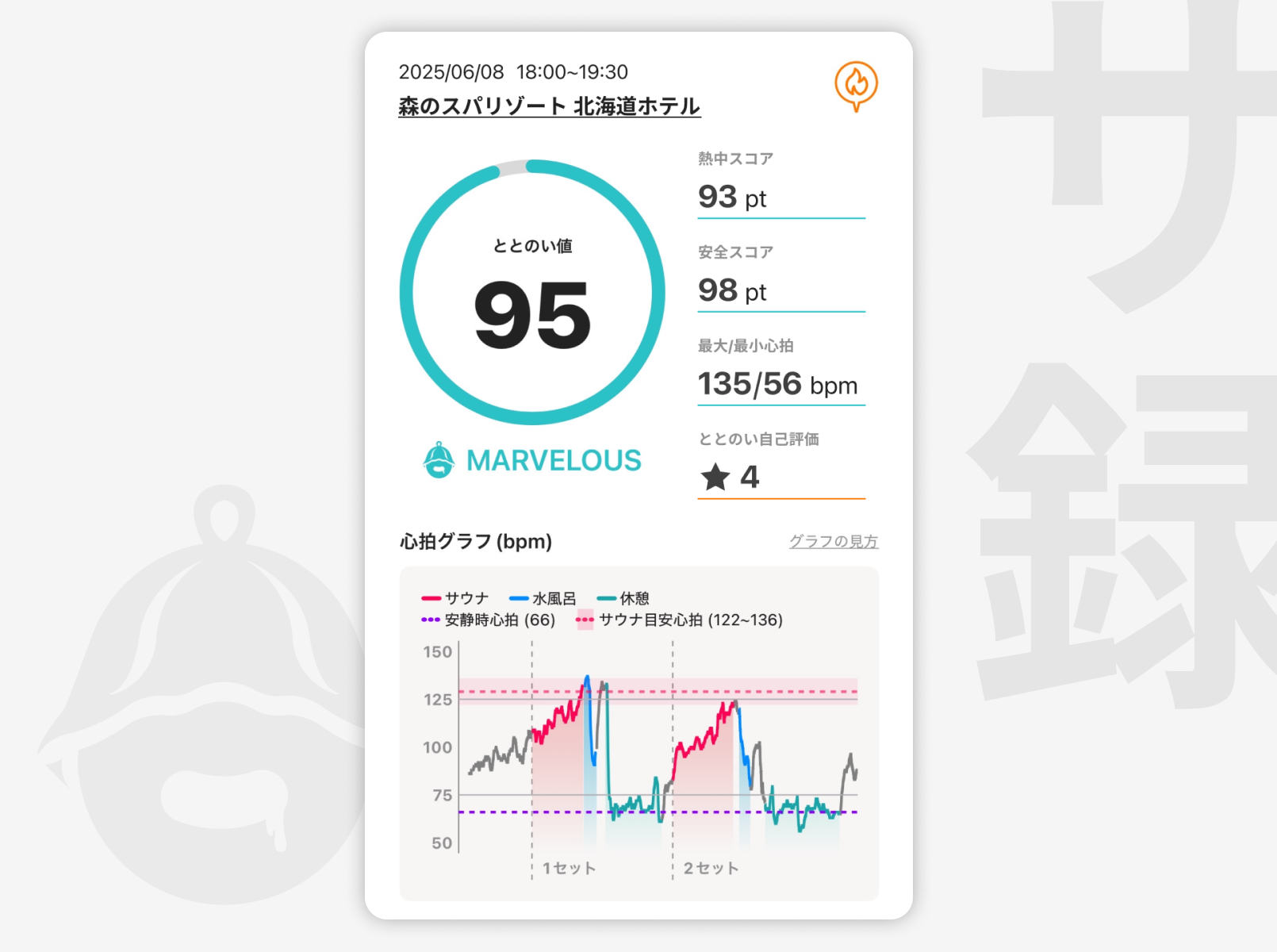
In your Totonoi Log, you can record and review various information about your sauna sessions!
Here, we will explain how to use the Totonoi Log and how to read the information!
■ T-Flow Score
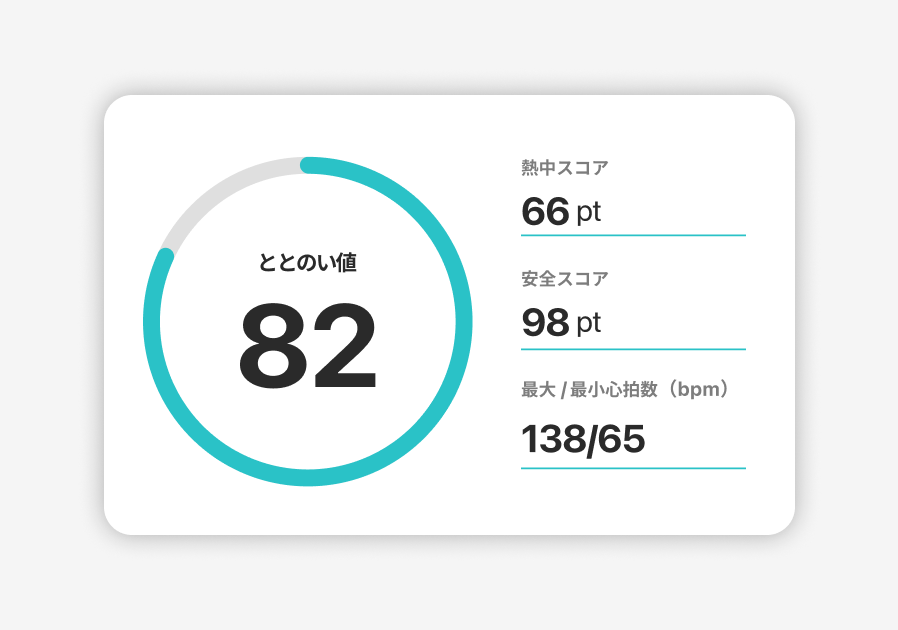
When you sync heart rate data measured with your sauna device to "Sanokuni" and create a Totonoi Log, your "T-Flow Score" will be displayed. The T-Flow Score is calculated from the values of your "Immersion Score" and "Safety Score".
It is scored with the ideal being "a state where autonomic nervous system activity is heightened while remaining relaxed" during rest after a cold bath.
□ Immersion Score: Push Score
This score evaluates whether you are effectively utilizing the "heat," which is the key appeal of saunas.
- Whether you are appropriately applying stress in the sauna and cold bath
- Whether your body is responding normally to the stress
It is scored from these perspectives. If you have already entered data in your Personal Info, that data will be referenced to display a more accurate score.
□ Safety Score: Overexertion Prevention Score
This score evaluates whether you are engaging in dangerous sauna practices by getting too immersed in the sauna.
- Whether the heart rate increase and maximum value are appropriate
- Whether you are experiencing a state like overheating
- Whether you are resting properly
It is scored from these perspectives.
Applying stress to your body tends to increase your Immersion Score, but if the stress becomes excessive, your Safety Score will decrease, resulting in a lower overall T-Flow Score.
💡 The current T-Flow Score algorithm (calculation method) is v2 and will continue to be improved. Announcements will be made for major updates.
■ Maximum / Minimum Heart Rate
For your maximum heart rate in the sauna, aim for a heart rate similar to doing light exercise where you can converse without feeling short of breath.
Ideally, your minimum heart rate should drop to your resting heart rate.
When you register your data in the Personal Info settings, it will be displayed on the heart rate graph as "Target Sauna Heart Rate". Try using this target heart rate as a guide for when to exit the sauna room.
■ Vital Graph
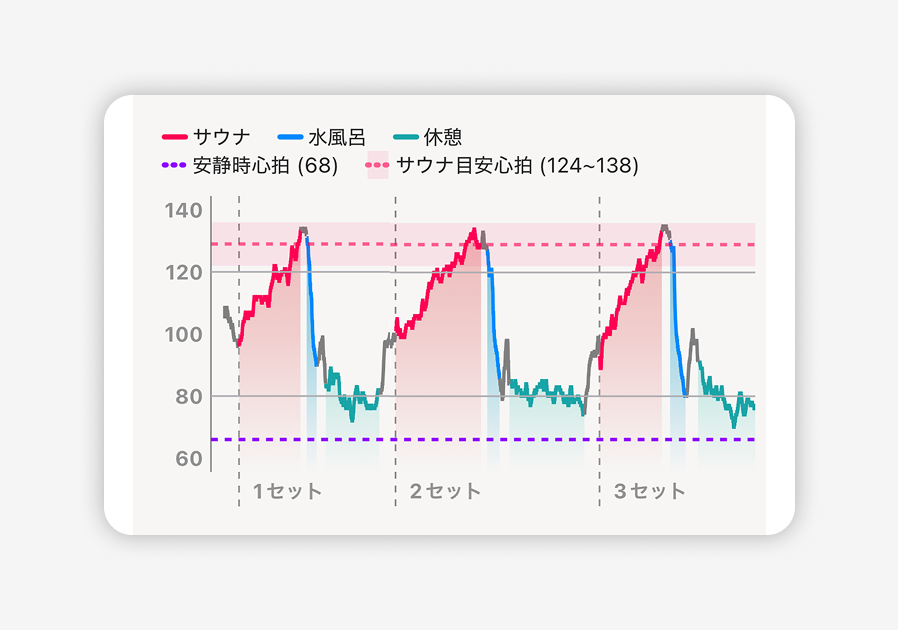
Heart rate rises in the sauna room, drops during the cold bath, and returns to normal after resting (outdoor air bathing). By keeping the heart rate rise in the sauna room gradual, you can reduce the strain on your body and activate the autonomic nervous system.
In Sanokuni, we analyze autonomic nervous system activity and balance from this heart rate data and reflect it in various scores.
We also display the "Target Sauna Heart Rate" based on resting heart rate and user body information.
↗️ How to read the Vital Graph
The retention period for heart rate graphs is 30 days, but with the 🔒 Premium Plan, the storage period is extended, allowing you to view heart rate data from past Totonoi Logs!
■ ANS Performance
🔒 Feature limited to Premium Plan
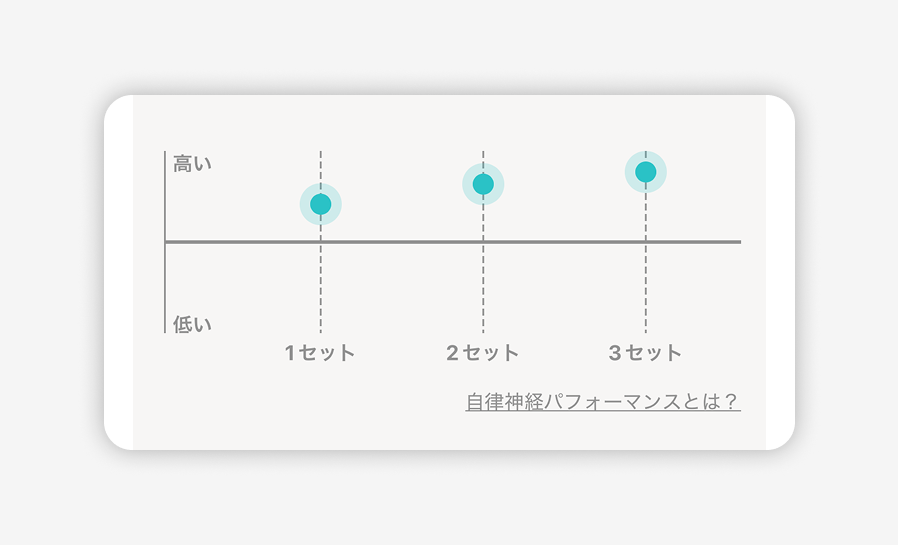
This graph shows the activity level of the autonomic nervous system during rest for each Set. You can see which Set was easiest to achieve totonoi and how it changed, helping you understand your preferred number of sets and rhythm trends.
How to read the ANS Performance graph
■ Doctor's Comments
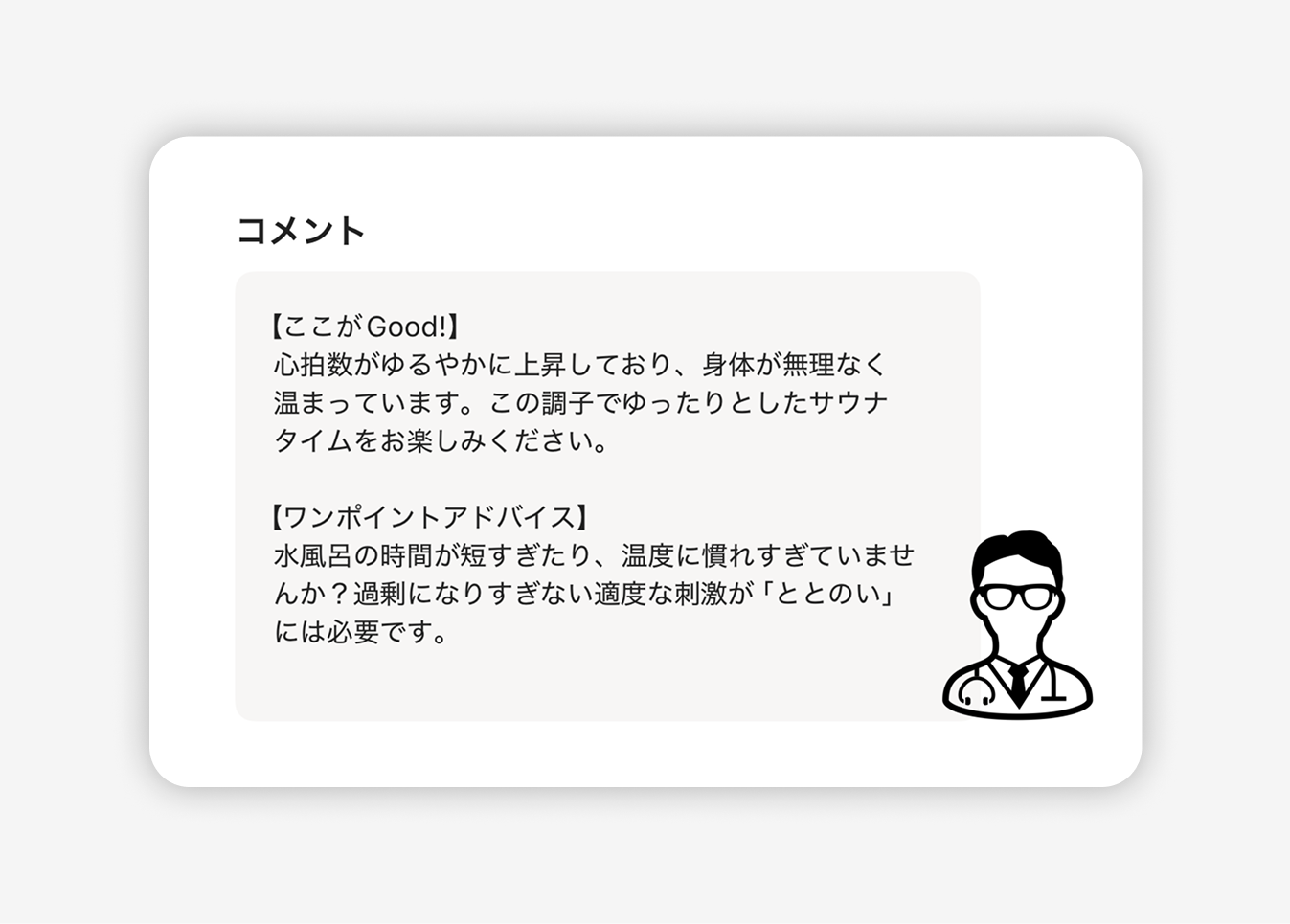
You will receive comments that help you interpret your data!
You can read about good points and get quick advice.
💡 The current advice feature is v2! It will continue to be improved. We will make announcements when major updates occur.
■ In-Depth Doctor AI Analysis
🟡 Available by spending Sanokuni Coins (Free for the first time)
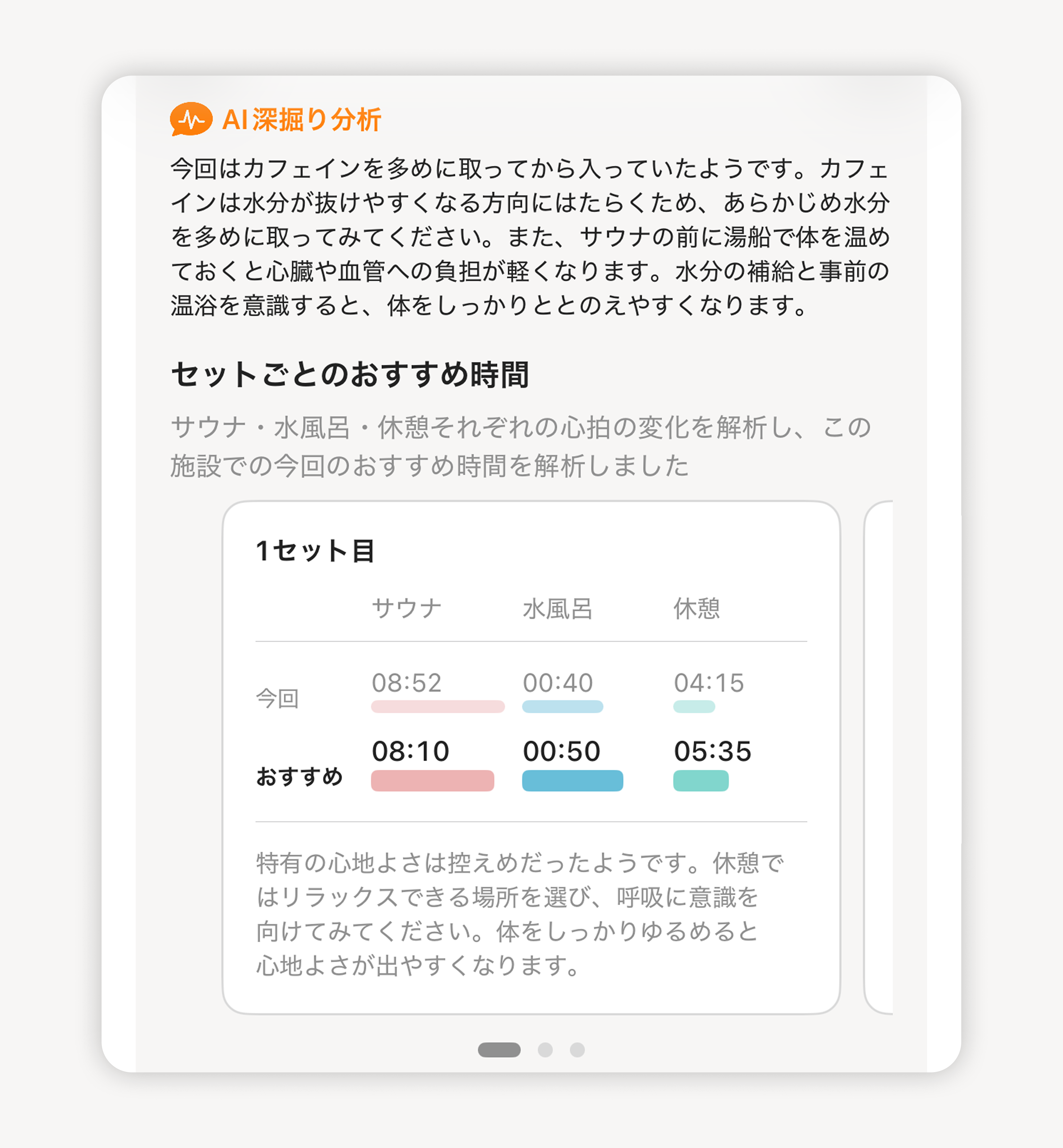
Doctor AI interprets Totonoi Log data (heart rate trends, duration of each Scene, reflection notes) to analyze the sauna session. It delivers insights that go a step deeper than the Doctor's Comments.
- Overall evaluation of the sauna session
- Evaluation for each Set (up to 15 Sets)
- Recommended duration for sauna, cold bath, and rest
* Content is subject to change with updates
□ How to Use
Execute "AI Deep Dive Analysis" from the Totonoi Log detail screen. The analysis will take a few minutes, and you will be notified via Push Notification once it is complete.
Sanokuni Coins are used for the analysis. You can try it for free the first time. For details on coins, please see About Sanokuni Coins.
□ Register recommended stay time to your sauna device
The recommended stay time presented in the analysis can be registered on the SAWATCH-3 as a "Sauna Mode Notification". When the registered time elapses, the device will notify you by vibration, allowing you to try taking a sauna session according to the analysis without checking the app.
□ Things to Keep in Mind
- Analysis can be performed once per Totonoi Log. Analyzed Totonoi Logs can be distinguished in the list.
- Analyzed Totonoi Logs cannot have their Scenes (divisions between sauna, cold bath, and rest) edited. If you want to fix Scenes, please edit them before performing the analysis.
- You can rate whether the received analysis was helpful from the Totonoi Log screen. Your ratings will be used to improve the analysis.
□ Notes
- The analysis is not a medical or health diagnosis, nor medical advice.
- The analysis text is generated by AI. It may misread your data or contain errors. Please treat it as one point ofreference.
- Always put how you feel that day ahead of the recommended durations. If you feel unwell in any way, stop and rest, regardless of what the analysis says.
■ Individual Set Details
🔓 Premium Plan can always view this
🟡 Also viewable by consuming Sanokuni Coins
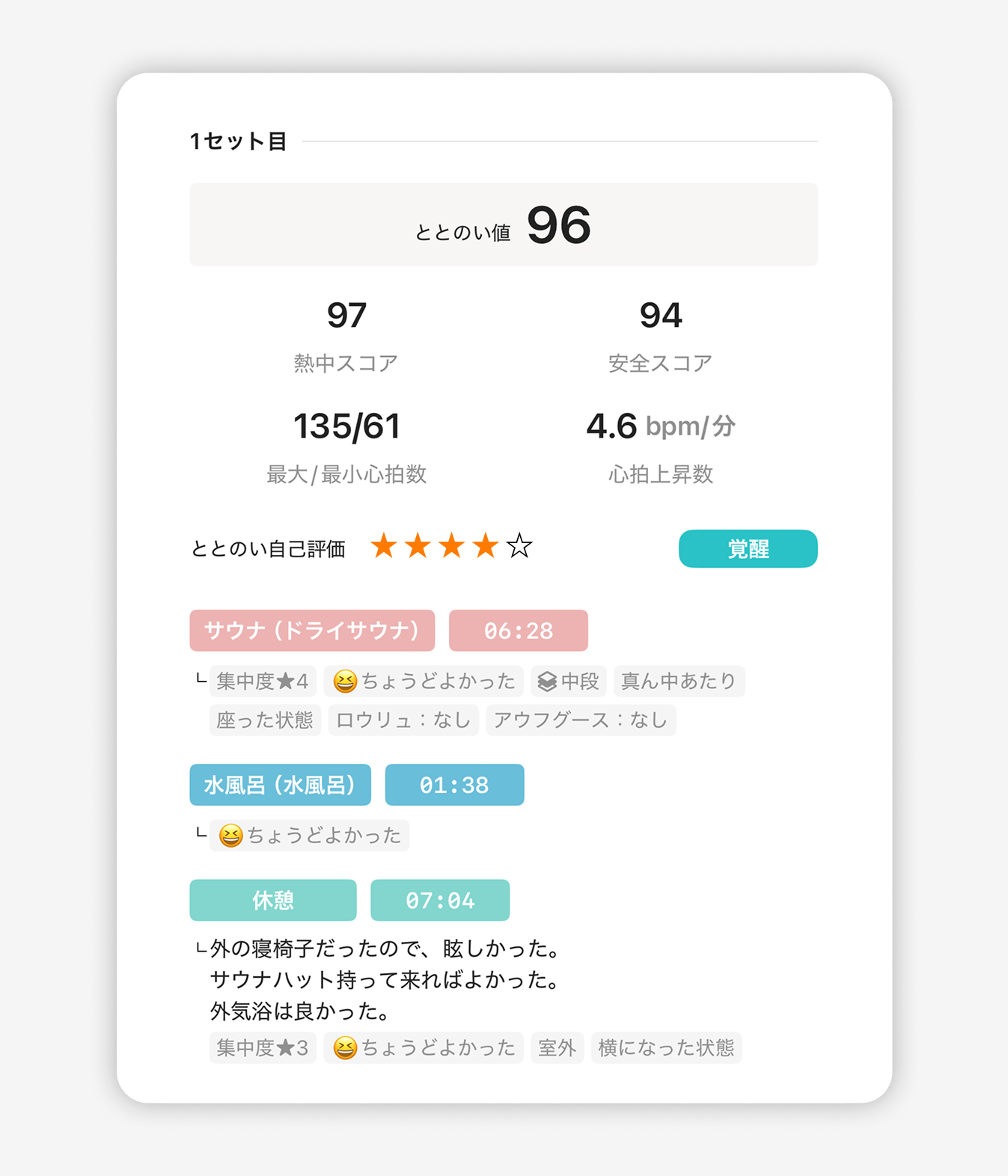
□ Heart Rate Increase
This is the amount of increase in heart rate per minute in the sauna room.
This is an indicator to check whether a sudden spike in heart rate that puts excessive strain on the body has occurred. If your Safety Score has dropped significantly, try comparing this value with other Sets and focus on warming up your body slowly.
□ Labels for Awakening and Floating
From the experiences and data of many sauna enthusiasts, it has become clear that differences in the sensation of "totonoi" can be broadly categorized into two tendencies.
The classification of "totonoi" tendencies displayed in the Set details of a Totonoi Log is based on an analysis of autonomic nervous system function. Sanokuni considers the "Awakening Type" to be the ideal "totonoi".
↗️ 2 Types of Totonoi - Awakening & Floating
■ Tips for Sauna Sessions
□ Understand and adjust for your fatigue and physical condition before entering the sauna
The calculation of the T-Flow Score includes the condition of your autonomic nervous system. If you enter the sauna under a heavy load when you are extremely tired, the function of your autonomic nervous system to regulate itself weakens, making it dangerous and resulting in a lower score. For example, during hot summer periods, your body may be weakened by daytime heat before entering the sauna. Hydrate beforehand, rest a little, assess your fatigue level, and adjust the heat strain in the sauna accordingly.
□ Avoid excessive strain
Do you think that "the more heat you endure, the better it feels"? Actually, this is a big mistake. If you push yourself too hard, even if you feel temporary exhilaration, it puts excessive strain on your autonomic nervous system, making it less enjoyable overall. Furthermore, it increases the risk of dizziness and fainting.
Observe your physical condition of the day, the temperature of the sauna room and cold bath, and your fatigue level after each Set, and adjust the strain within a comfortable range. Especially in summer, ambient outdoor temperatures can easily drain your strength, requiring more careful judgment.
□ Quietly focus on your own sensations
Even during a sauna session, your bodily functions and sensations change and are not constant. For example, your body's condition changes between the 1st Set, 2nd Set, and 3rd Set as it gets used to the heat or becomes fatigued. Pay attention to how your heart rate rises and focus on the sensations in your body.
If you feel you are heating up a bit too quickly, move to a lower bench; if it is too slow, move to an upper bench. If you feel your heart rate has risen too much, take a longer cool-down time. Adjust according to your own sensations. Keeping checks on your sauna device to a minimum will help you focus on your own body's signals.
□ Breathing tends to become shallow in the sauna and cold bath, so make sure to breathe deeply and steadily
In a hot sauna or cold bath, breathing subconsciously tends to become shallow. Shallow breathing causes the sympathetic nervous system to overwork, disrupting the balance of the autonomic nervous system. As a result, your heart rate rises before you get sufficiently warm in the sauna, and it becomes harder to feel refreshed in the cold bath.
Since autonomic nervous system stability is crucial for the T-Flow Score, be conscious of deep, steady breathing in both the sauna and cold bath. Note that in ultra-high temperature saunas, inhaling can hurt your nose and throat, so it is safer to cover your face and mouth with a towel while breathing.
□ Cool down properly after each Set (neither too short nor too long)
After warming up thoroughly in the sauna, it is important to cool down your body appropriately in a cold bath or during open-air rest. Insufficient cooling down excessively stimulates the autonomic nervous system, increasing risks such as dizziness and fainting, and actually weakening the sense of refreshment.
On the other hand, if you stay in the cold bath too long and chill yourself to the core, or if your break is too long—such as falling asleep during rest—your body will not warm up easily during the next sauna session, causing you to stay in the sauna longer than necessary and draining your stamina. Keep a balance of "neither too long nor too short" for both the cold bath and rest, and cool down with the intention of resetting your condition after every Set.